


Many companies are growing fast in revenue, but at the bottom of the line they have little left over. More customers are coming in, the organization is growing, and the sales reports look positive. Yet the pressure on cash flow, margin and capacity often increases.
Growth feels good, but revenue growth without control can actually make your business more vulnerable. After all, more revenue doesn’t automatically mean more profit. If margins fall, costs rise faster or customers pay late, growth can even lead to less financial room.
Therefore, the real question is not just: how much revenue do we make? The better question is: how much return do we retain and how scalable is our growth?
In this article, you’ll discover what successful companies are really driving and how you yourself can move from revenue to profitability.
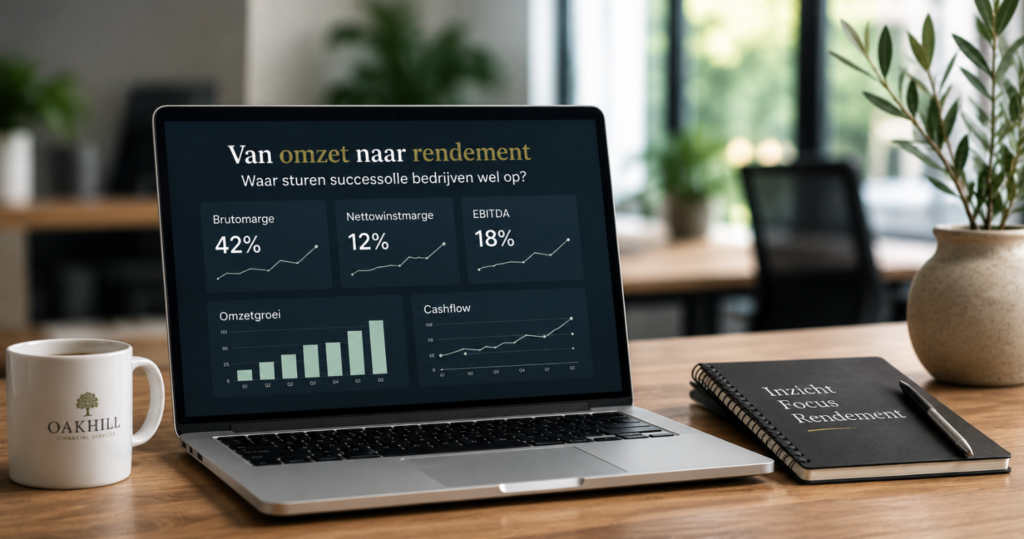
Which is more important: revenue or profitability?
Profitability is more important than turnover when you want to assess whether a company is growing healthily. Revenue shows how much is sold, but return shows how much value is actually left after costs, investments, working capital and operating pressures.
- Turnover shows volume: how many customers, orders or sales were made.
- Yield shows quality: how much profit, margin and cash flow the sales generate.
- Healthy growth requires both: revenue growth is valuable if it remains scalable, profitable and fundable.
- Successful companies manage more broadly: they look at margin, EBITDA, cash flow, customer value and revenue per employee.
Why turnover is not a good indicator
Sales are visible, easy to measure and often the first figure business owners look at. Yet revenue itself is a misleading measure. This is because it says little about profitability, cash flow, risk and the quality of growth.
A company can grow in sales and still perform worse financially. This happens, for example, when additional sales are only possible because of lower prices, higher personnel costs, more inventory, longer payment terms or additional management pressure.
A simple example:
- Situation 1: €1,000,000 sales with 20% gross margin yields €200,000 gross margin.
- Situation 2: €1,300,000 sales with 12% gross margin yields €156,000 gross margin.
In the second situation, sales have increased by €300,000, but the bottom line has deteriorated. The business has become busier, more complex and probably more vulnerable, while leaving less margin.
That’s why turnover is sometimes a vanity metric: the number looks good, but doesn’t tell you whether the company is really getting stronger.
The difference between revenue growth and healthy growth
The difference between sales growth and healthy growth is in the quality of sales. Revenue-driven companies steer primarily toward more sales. Return-driven companies steer for profitable, manageable and scalable growth.
Revenue-driven growth
In revenue-driven growth, the focus is often on volume. The commercial organization wants more customers, more orders and a higher top line. This can work well, but carries risks when financial steering lags.
Typical characteristics of revenue-driven growth are:
- Focus on volume: more clients and more orders are more important than the quality of sales.
- Pressure on price: discounts are used to win deals, without always calculating what this does to margin.
- Growth without control: processes, reporting and cash flow do not grow with commercial ambitions.
- More complexity: additional revenue creates more staff, more administration and more operational pressure.
Return-driven growth
Yield-driven growth starts with asking what revenue really contributes to profit, cash flow and value creation. Successful companies make conscious choices in customers, pricing, capacity and service delivery.
Typical characteristics of return-driven growth are:
- Focus on margin: not every euro of revenue is equally valuable.
- Conscious choices: customers, products and services are evaluated for profitability and strategic value.
- Scalable growth: processes, people and systems can grow with you without costs rising faster than revenues.
- Better cash flow: growth is linked to working capital, payment terms and liquidity planning.
So more is not always better. Better is better: better customers, better margins, better processes and better control information.
What do successful companies steer by?
Successful companies steer not just by revenue, but by a combination of financial KPIs that show whether growth is adding value. These KPIs provide insight into profitability, efficiency, cash flow and scalability.
Gross margin
Gross margin shows how much is left over after direct costs. This is often the first indicator of whether sales are good quality.
Mini example: a company is growing in sales, but gross margin drops from 35% to 25%. This could mean excessive discounting, rising purchasing costs or bringing in less profitable customers.
Net profit margin
The net profit margin shows what portion of sales is ultimately left as profit. This is important because overhead, personnel costs, financing costs and tax burden all affect the bottom line.
Mini example: a company with €5 million in sales and 3% net profit retains €150,000. A company with €3 million in sales and 10% net profit retains €300,000. The smaller company then performs financially stronger.
EBITDA
EBITDA provides insight into operating profitability before interest, tax, depreciation and amortization. For business owners, banks and investors, this is often an important measure to assess the company’s performance.
Mini example: if sales increase but EBITDA remains the same, it means that the additional sales barely contribute to operating profit. Then it is necessary to examine where the margin is leaking away.
Turnover per employee
Turnover per employee shows how efficiently the organization is growing. When turnover increases, but the number of employees increases even faster, productivity can be strained.
Mini example: a company grows from €4 million to €5 million in sales, but its workforce grows from 20 to 32 employees. Revenue increases, but revenue per employee decreases. This may indicate inefficiency or insufficient scalability.
Customer value versus acquisition cost
Not every customer is equally profitable. Successful companies look at the value of a customer over time and compare that to the cost of bringing in and serving that customer.
Mini example: a customer generates a lot of revenue, but requires a lot of customization, support and management time. A smaller customer with less complexity may end up being more profitable.
Cash flow and cash conversion
Profit is important, but cash flow determines whether you can pay liabilities. Cash conversion shows how quickly profits are converted into available cash.
Mini example: a company makes a profit, but customers don’t pay until 75 days on average. This creates pressure on the bank account, especially when salaries, VAT and suppliers must be paid earlier.
For structural steering on these types of KPIs, good financial reporting is essential. Without reliable monthly reports, returns often remain a feeling rather than a measurable steering tool.
The role of pricing in returns
Companies often focus on cost cutting when returns are under pressure. That makes sense, but pricing strategy is usually a much greater lever. A small price adjustment can have an immediate effect on margin and profitability.
Yet many business owners avoid raising prices. They fear losing customers, are uncomfortable discussing price or compare themselves too much with cheaper competitors.
Therefore, it is important to distinguish between price and value:
- Price: what the customer pays.
- Value: what the customer gets in return in results, convenience, security, speed or quality.
- Margin: what your company is left with after expenses are paid.
A price increase of a few percent can have much effect when the cost base remains largely the same. KVK also mentions when determining selling prices that business owners should take into account operating costs and add a profit margin. Read more about cost price and sales price calculation.
A good pricing policy starts with insight:
- Which customers are profitable?
- Which products or services have the highest margin?
- Where are we providing too much customization without appropriate compensation?
- What price increase is defensible based on value?
- What is the effect of price adjustment on sales, margin and customer retention?
So improving profitability doesn’t just mean cutting costs. It often starts with sharper choices, better pricing and targeting customers who contribute to healthy growth.
How Oakhill helps grow profitably
Oakhill Financial Services helps entrepreneurs move from revenue to profitability. Not just by reporting numbers, but by actively thinking about profitability, cash flow, pricing, financial structure and scalable growth.
We work as a strategic financial partner for SMEs and scale-ups that need more control over their numbers. In doing so, we combine operational financial knowledge with strategic insight.
Our support focus includes:
- Insight into returns: reports that show which customers, services or activities really contribute to profits.
- Managing KPIs: monthly dashboards showing revenue, margin, EBITDA, cash flow and working capital.
- Pricing and margin analysis: understanding price, cost, margin and customer value.
- Cash flow planning: looking ahead to liquidity, liabilities and financing needs.
- Strategic decision-making: contributing ideas on growth, investment, financing and organizational design.
Through our CFO as a Service, we support entrepreneurs who need strategic financial direction without directly hiring a full-time CFO.
For companies that need more structure in monthly figures, dashboards and management information first, we offer support through Controlling as a Service.
From growth to healthy growth
Healthy growth requires more than commercial ambition. It requires reliable figures, sharp choices and a clear translation of sales into returns.
Oakhill helps entrepreneurs look not only at what’s coming in, but more importantly at what’s left over. This creates a business that is not only bigger, but stronger, more profitable and more fundable.
Do you want to manage for return instead of just revenue?
Growth is only truly valuable when it is profitable, scalable and fundable. Want better insight into margin, cash flow, KPIs and healthy growth? Oakhill Financial Services helps you move from revenue to profitability.
Contact Oakhill for a free consultation on financial management and profitable growth.
Frequently asked questions about sales, returns and healthy growth
Which is more important: revenue or profitability?
Yield is more important when you want to assess whether a company is growing financially sound. Sales show how much is sold, but yield shows how much profit, margin and cash flow sales actually generate.
Why can turnover growth be dangerous?
Revenue growth can be dangerous when costs, personnel, inventory or working capital rise faster than revenues. Then the business becomes busier and more complex, while profitability falls.
What KPIs are important for profitability?
Key KPIs for profitability include gross margin, net profit margin, EBITDA, revenue per employee, customer value versus acquisition cost, cash flow and cash conversion.
How can pricing help improve returns?
Pricing helps improve returns because a small price adjustment can have an immediate effect on margin and profit. Especially when the cost base remains largely the same, better pricing can provide great leverage.
When does my company need financial steering?
Your company needs financial steering when sales are growing but profits, cash flow or margins are lagging. Financial steering is also important when there is rapid growth, investment decisions, financing questions or limited management information.